Internal proxy
Modules call each other through the internal proxy, in memory. External traffic - browsers, API clients, webhooks - enters through the HTTP kernel and its full middleware stack; a call from one module to another never does.
| Traffic | Path | Cost |
|---|---|---|
| External | HTTP kernel: ASGI, firewall, session, CSRF, middleware, routing | a full request |
| Internal | proxy.call / proxy.dispatch: container lookup, method call |
one function call |
Measured with tests/benchmark_internal_proxy.py (real kernel under uvicorn,
one process, one database read per call):
| Same service method reached through | Mean per call |
|---|---|
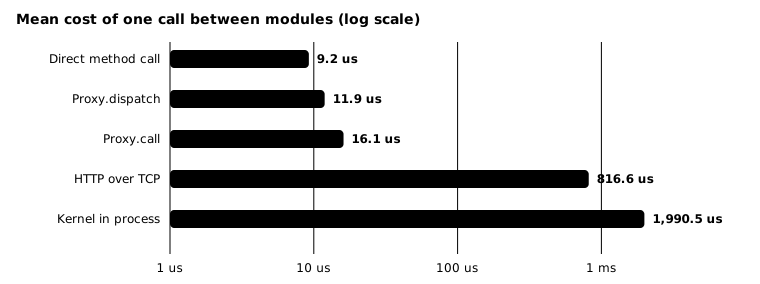
| direct method call | 9 us |
Proxy.call / Proxy.dispatch |
12-16 us |
| HTTP over TCP, keep-alive | 817 us |
| the kernel in process (ASGI, no socket) | 1,990 us |
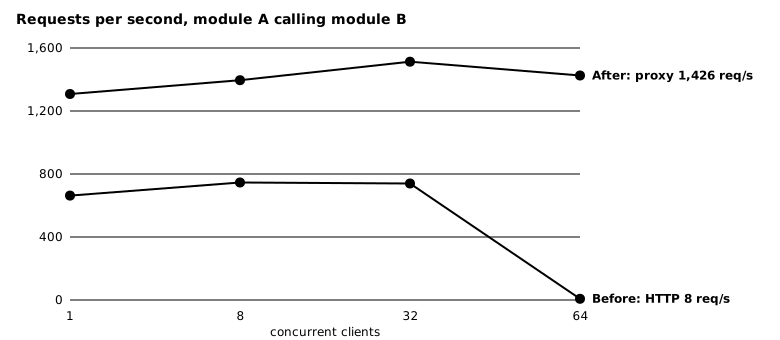
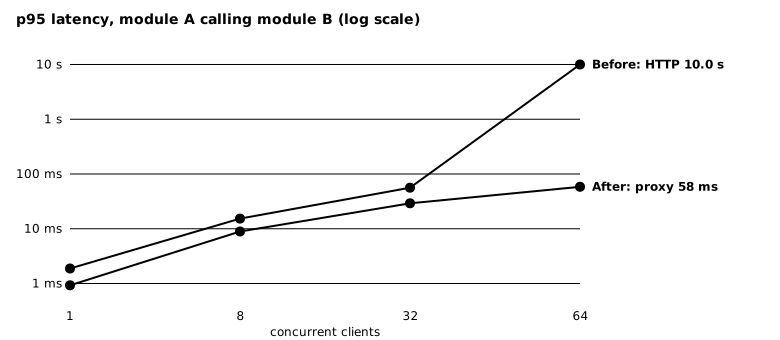
End to end, an external request whose module calls another module serves about twice the requests per second through the proxy as through a loopback HTTP call, at half the latency. A loopback request also holds two thread-pool workers; with the default 40, 64 concurrent clients deadlock the pool (8 req/s, 10-second timeouts) while the proxy keeps serving about 1,400 req/s. The full results are in Benchmark: before and after.
The proxy is routing infrastructure only. It holds no tenant, authorization or
business rule. Every target runs on the caller's own thread, so it shares the
caller's context - tenant, user, locale, request id - its pooled database
connection and any transaction the caller has open. Tenant isolation stays with its two barriers: the module's own code
and the database's row-level security. The decision is recorded in ADR 0003
(docs/adr/0003-engine-boundary-and-internal-proxy.md in the repository).
Exposing a service
Nothing is callable until a module exposes it. Declare it in the module's service provider:
from craft.providers import ServiceProvider

from app.Modules.Billing.BillingService import BillingService


class BillingServiceProvider(ServiceProvider):
    def register(self) -> None:
        self.app.bind(BillingService)

    def boot(self) -> None:
        self.app.make("proxy").expose("billing", BillingService, {"generate_invoice"})
expose refuses, at boot:
- an alias another module already exposed - no module can take over another's;
- a private (
_name) or empty method name; - a method the class does not define, so a typo fails before the first call
(checked when
exposereceives the class itself).
Calling an alias or a method that was not exposed raises InternalProxyError
with a machine code:
| Code | Meaning |
|---|---|
INTERNAL_TARGET_NOT_EXPOSED |
no module exposed this alias |
INTERNAL_METHOD_NOT_EXPOSED |
the alias exists, the method was not exposed |
INTERNAL_ASYNC_HANDLER_FROM_SYNC_CALL |
call on a target that is or returns an awaitable; use dispatch |
INTERNAL_DURABLE_EVENT |
emit of an event marked durable = True |
INTERNAL_ALIAS_ALREADY_EXPOSED |
expose of an alias that is already taken |
INTERNAL_EXPOSE_PRIVATE_OR_EMPTY_METHOD |
expose of a private or empty name |
INTERNAL_EXPOSE_UNKNOWN_METHOD |
expose of a method the class lacks |
INTERNAL_TARGET_UNAVAILABLE |
the owning extension cannot serve right now (circuit open) |
Exposures owned by an extension
An extension exposes through its context, which makes it the owner
(documentation/extensions.md):
def register(context):
    context.expose("billing", BillingService, {"generate_invoice"})
An owned alias follows its extension's health and lifecycle:
| Situation | Effect |
|---|---|
| the extension is deactivated | the alias is withdrawn: INTERNAL_TARGET_NOT_EXPOSED |
| its circuit breaker is open | the call is refused without running the target: INTERNAL_TARGET_UNAVAILABLE |
| the target raises an unexpected exception | it reaches the caller unchanged and counts toward the owner's breaker |
| the target raises a typed domain error (status below 500) | it reaches the caller unchanged and is not counted |
expose(alias, service, methods, owner="slug") and unexpose(alias) are the
underlying calls; set_gate(gate) installs what decides whether an owner may
run (the extension manager does it at boot).
Calling another module
from craft.facades import Proxy


class CheckoutController:
    def complete(self, request):
        # The order module asks billing for an invoice: no HTTP, no middleware.
        invoice = Proxy.call("billing", "generate_invoice", request.input("order_id"))
        return {"invoice_id": invoice.id}
From async code, dispatch calls the target and awaits whatever it returns:
invoice = await Proxy.dispatch("billing", "generate_invoice", order_id)
A synchronous target runs inline on the caller's thread, never on a worker thread: on another thread it would borrow a second pooled connection, outside the caller's transaction, that nothing returns. The engine runs async actions on the request's own worker thread, so this does not block the server's event loop.
The proxy resolves the target through the container, so it is also available
by injection (InternalProxy in a constructor) or as app.make("proxy").
Events
Proxy.emit(event) delivers an in-memory event to its listeners. An event
class marked durable = True - money movements, anything that must survive a
crash - is refused: it belongs to a queued job or an outbox, not to memory.
Rules
- A module never imports another module's code; it calls an exposed service
through the proxy, emits an event, or depends on a contract. Between
extensions the boundary gate enforces it (
EXTENSION_CROSS_IMPORT). - A module never calls another module over HTTP inside the same application.
- The engine never imports the application. The boundary gate
(
tools/check_engine_boundary.py) enforces it in CI.
Benchmark: before and after
Before the internal proxy, one module reached another with a loopback HTTP request through the kernel. After it, the module calls the service through the proxy, on the same thread and inside the same transaction. Both were measured on the real kernel under uvicorn, against the same service method, which performs one database read.
Measured on 2026-10-04 at commit 480dd2b, in the framework container:
Python 3.14.7, uvicorn 0.53.0, 8 CPUs, one process, 40 thread-pool workers, a
throwaway SQLite file, keep-alive connections, five seconds per load scenario.
The raw report is assets/proxy-benchmark.json.
Cost of one call
| Path | Calls/s | Mean | p50 | p95 | p99 |
|---|---|---|---|---|---|
| Direct method call | 105,926 | 9.2 us | 8.1 us | 14.5 us | 20.3 us |
Proxy.dispatch |
82,585 | 11.9 us | 11.7 us | 12.3 us | 19.2 us |
Proxy.call |
61,201 | 16.1 us | 14.8 us | 25.7 us | 30.9 us |
| HTTP over TCP, keep-alive | 1,224 | 816.6 us | 767.4 us | 1,197.9 us | 1,543.0 us |
| Kernel in process (ASGI, no socket) | 502 | 1,990.5 us | 1,878.8 us | 2,473.2 us | 3,234.5 us |
The proxy adds a few microseconds over a direct call; the same call over HTTP
costs about 50 times more. The gap between call and dispatch is measurement
order, not a property of either: both run the target inline.
Requests end to end
An external request reaches module A through the full kernel; module A then reaches module B through the proxy (after) or a loopback HTTP request (before).
| Clients | Before: req/s | After: req/s | Before: p95 | After: p95 | Before: failures | After: failures |
|---|---|---|---|---|---|---|
| 1 | 663 | 1,308 | 1.88 ms | 0.93 ms | 0 | 0 |
| 8 | 746 | 1,395 | 15.36 ms | 8.89 ms | 1 | 0 |
| 32 | 740 | 1,513 | 56.15 ms | 29.11 ms | 15 | 0 |
| 64 | 8 | 1,426 | 9,983 ms | 58.36 ms | 89 | 0 |
At 64 clients the loopback pattern deadlocks: each loopback request holds two of the 40 workers, so every worker ends up waiting on an inner request that needs a worker. The proxy holds one worker per request.
The test suite, before and after
| Before (v4.1.0, published) | After (2026-10-04, commit 4b9d3a6) |
|
|---|---|---|
| Passed on PostgreSQL 18.6 | 1,758 | 1,834 |
| Passed on SQLite | 1,696 | 1,772 |
| Tests | 1,762 | 1,838 |
| Test files | 106 | 111 |
| Failures | 0 | 0 |
Reproduce it
python tests/benchmark_internal_proxy.py --json proxy-benchmark.json
python tools/render_benchmark_charts.py proxy-benchmark.json

# the same, against an isolated PostgreSQL database and two worker processes
python tests/benchmark_internal_proxy.py --database pgsql --workers 2 --json proxy-benchmark-pgsql.json
--database picks sqlite (a throwaway file, the default) or pgsql (an
isolated craft_* database, created if absent and never dropped); --workers
serves from that many uvicorn worker processes instead of one in-process server.
Absolute numbers move with hardware, database and worker count. The ratios and
the deadlock at twice the pool size come from the architecture, and they hold on
PostgreSQL and with several workers — see
reports/20261007-internal-proxy-benchmark-postgres-and-workers.md.